BRIEF-02
Bloomington banned superintelligence. Its own statute says it couldn't.
A 7–0 vote, $2,500-a-day fines, and a repeal clause that needs 95% of every registered voter. The ordinance cites one law. That law forbids three things the ordinance does. Here is the record, and a complaint an Indiana lawyer can file.
Key points
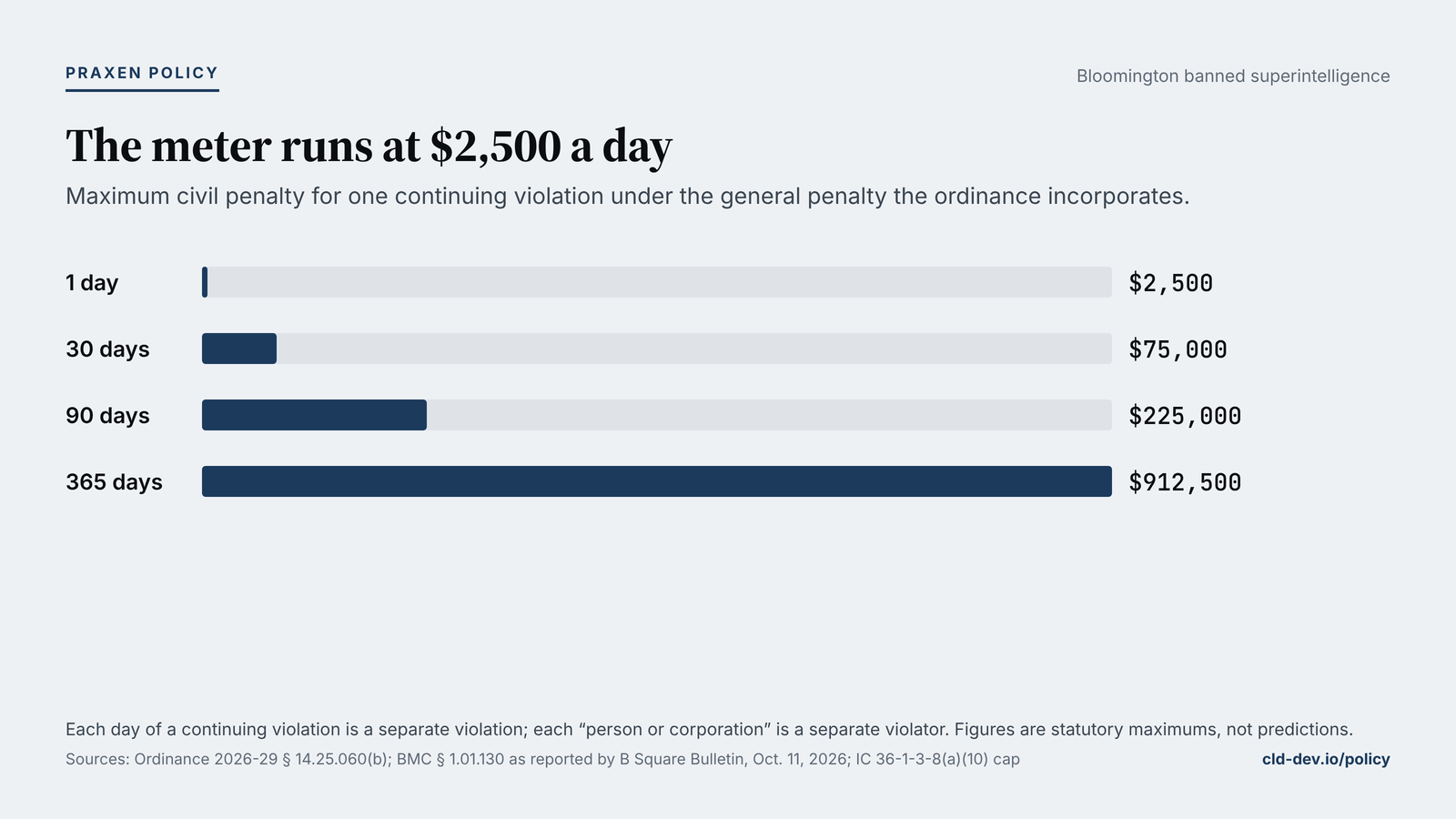
- On November 4, 2026, Bloomington’s Common Council adopted Ordinance 2026-29 by a 7–0 vote. It bans distributing or deploying “Superintelligence” inside the city, reaches software served “regardless of the physical location of the server,” and carries fines of up to $2,500 per violation per day.12
- The ordinance cites one source of authority, the Indiana Home Rule Act, IC 36-1-3, with no section number. Section 8(a) of that Act lists sixteen powers a city “does not have.” The ordinance exercises at least three of them: conducting an election (§ 8(a)(12)), prescribing the law of private civil suits (§ 8(a)(2)), and legislating beyond the corporate boundary (§ 9(b)).3
- The sponsor’s memorandum states that the targeted systems “are untestable,” that the ordinance “prevents outside commercial tech entities” from deploying in Bloomington, and that it “can help plaintiffs meet their burden of proof” in private lawsuits. Each sentence is an admission against the City on a separate legal theory.4
- The repeal clause requires an affirmative vote of more than 95% of registered voters, not ballots cast. A unanimous vote fails unless turnout exceeds 95%. Indiana law bars cities from holding elections a statute does not authorize.13
- Four federal executive orders since January 2025 declare a national policy against patchwork and extraterritorial AI regulation, and a Justice Department task force exists to sue over it. None of that preempts a city ordinance. A private suit under Indiana’s own enabling statute and the Commerce Clause does the work; this brief publishes one.56
What Bloomington did
Councilmember Dave Rollo has tried three times in three years to get a government to act against artificial intelligence. A 2023 resolution was withdrawn after Indiana University objected. A June 2026 resolution asking other governments for a moratorium passed 9–0.78 The third attempt does not ask anyone. It changes Bloomington’s municipal code.
Ordinance 2026-29 adds Chapter 14.25, “Prohibition of Superintelligence,” to Title 14 of the code. The operative sentence reads: “No person or corporation shall distribute or permit to be distributed nor deployed into the premises of any citizen or business in our City, any Superintelligence for any purpose.” Deployment “shall include the remote execution, activation, or utilization of any unauthorized digital agent through a locally accessed interface, browser, API, or connected hardware within the City of Bloomington, regardless of the physical location of the server infrastructure hosting the system.”1
“Superintelligence” is defined in a single 130-word sentence that ends: “Any intellect that greatly exceeds the cognitive performance of humans in virtually all domains of interest.” Violations fall under the code’s general penalty, up to $2,500 per violation, with each day of a continuing violation counted separately. Enforcement belongs to the Department of Law and the police, “as a matter of discretion,” with referral to the county prosecutor “where appropriate.”17
The ban lifts only if the Council later finds two things: “broad scientific consensus” of safety at “99.9999% percent certainty,” and “an affirmative vote of more than 95% of registered voters.”1 It expires on its own only if the Indiana General Assembly enacts “a comprehensive framework for Provably Safe Superintelligence.”
The text adopted on November 4 is the text introduced on October 14. No amendment was offered. No memorandum from the City’s Department of Law appears in either packet. The bond ordinance considered the same night came with a memo co-signed by Corporation Counsel. This one came from the sponsor’s office alone.9
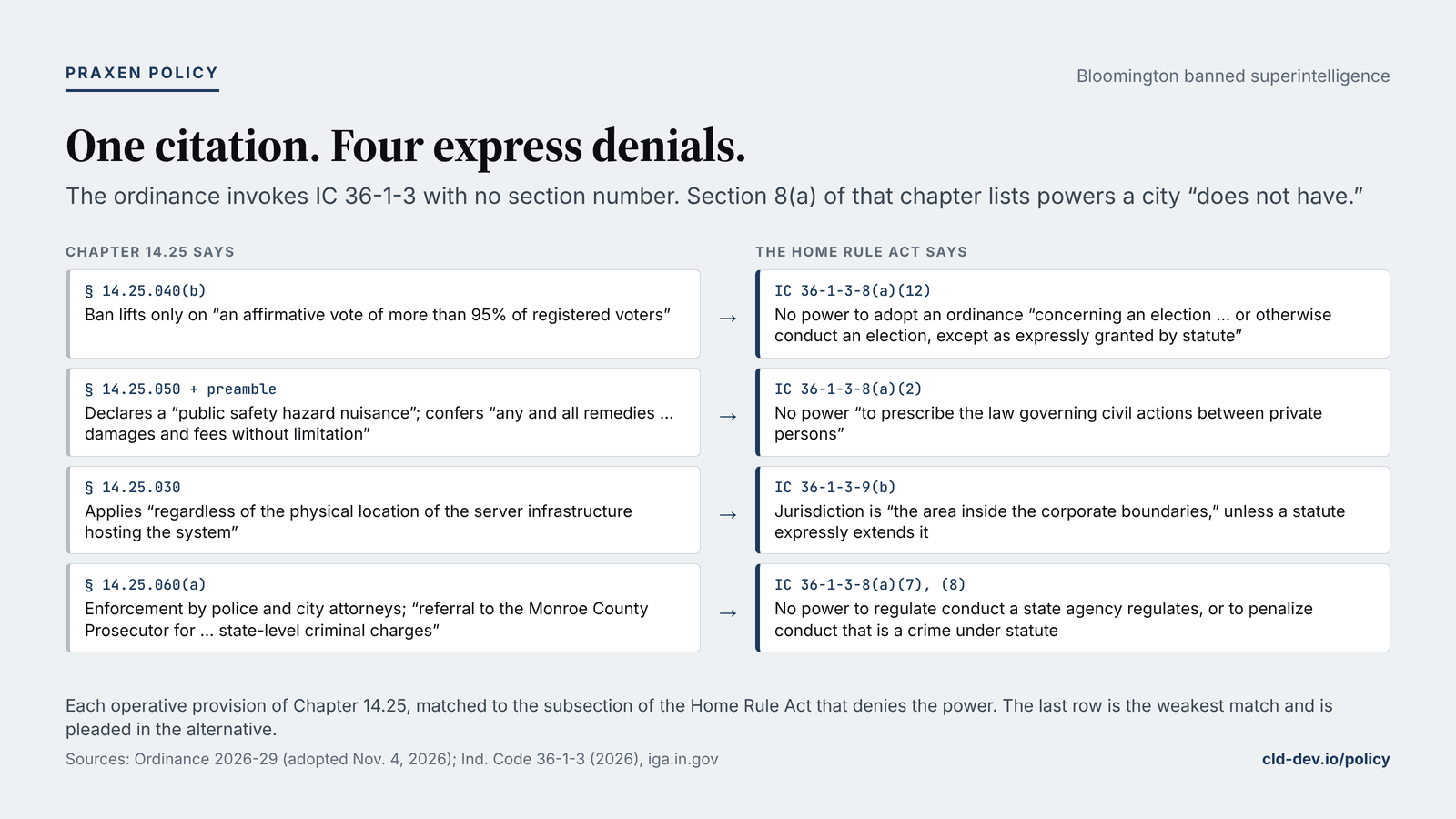
The ordinance cites one law. Here is what that law says.
The preamble invokes “the traditional police powers of the City and Indiana Code § 36-1-3 (The Indiana Home Rule Act).” The sponsor’s memo calls this “sovereign authority to regulate public safety hazard nuisances.” Neither document cites a section.14
The Home Rule Act is generous. It abolishes the old rule that doubts about a city’s power are resolved against the city, and it grants “all other powers necessary or desirable in the conduct of its affairs.” But it grants them only “to the extent that the power … is not expressly denied by the Indiana Constitution or by statute,” and then, in section 8(a), it expressly denies sixteen of them.3 Three are in play.
Section 8(a)(12). A city does not have “[t]he power to adopt an ordinance … concerning an election … or otherwise conduct an election, except as expressly granted by statute.” Chapter 14.25 conditions its own repeal on a city-wide vote of registered voters. No statute authorizes Bloomington to hold one. The sponsor’s memo says the point of the clause is that “the ultimate authority to lift the ban is left completely to the local electorate.”4 An ordinance “concerning an election” that the city cannot hold is void on its face.
Section 8(a)(2). A city does not have “[t]he power to prescribe the law governing civil actions between private persons.” The ordinance declares the technology a “public safety hazard nuisance,” which is a rule of decision in private nuisance suits, and confers “any and all remedies available at law to recover damages and fees without limitation” on anyone harmed by a violation. The memo explains why: “this ordinance and others like it can help plaintiffs meet their burden of proof,” and the resulting liability “could be profound enough to prevent any insurers from providing product liability insurance.”4 That is a description of prescribing the law of private civil actions.
Section 9(b). “The area inside the corporate boundaries of a municipality comprises its territorial jurisdiction,” unless a statute says otherwise. The ordinance regulates “regardless of the physical location of the server infrastructure.” No statute extends Bloomington’s reach to a data center in Virginia.3
A fourth provision, section 8(a)(7), bars regulating “conduct that is regulated by a state agency.” The memo asserts that Indiana has enacted nothing. In fact the General Assembly chartered an AI task force in 2024, the Office of Technology inventories and assesses AI systems under IC 4-13.1-5, the state adopted an AI policy built on the NIST framework, and the Consumer Data Protection Act took effect this January.101112 But that regime governs state agencies and profiling, not private deployment, and I would not lead with it. The first three do not need it.
The sponsor’s memo does the plaintiff’s work
Litigators spend discovery looking for the sentence in which the other side says what it was really doing. Here the sentences are in the public record, under the sponsor’s name, attached to the ordinance at both readings.4
On vagueness: “These models are untestable because the developers do not understand how their neural networks work. … In short, they are becoming untestable.” The ordinance’s operative test is whether a system “greatly exceeds the cognitive performance of humans in virtually all domains of interest.” The enacting body says that test cannot be run.
On the Commerce Clause: the ordinance “prevents outside commercial tech entities from making high-risk deployments in Bloomington without local permission,” and “[i]f those (approximately 350) cities passed similar ordinances in the coming weeks or months, this would create a massive regulatory burden for companies creating ASI.” A law passed to burden out-of-state companies as such gets the strictest scrutiny a court has.
On the City’s own enforcement capacity: the fiscal statement says the ordinance “will [not] have any impact on the City’s finances.” No budget, no staff, no detection method. The memo also cites “Section 2.90.040 of Ordinance 2026-29” for enforcement discretion. No such section exists. The reference survived from the October draft into the November packet, which suggests the text was adapted from a template and that nobody in the Department of Law read it closely.49
The definition the City says cannot be tested
Vagueness doctrine asks two questions: does the law give a person of ordinary intelligence fair notice of what is prohibited, and does it give enforcers a standard.13 Chapter 14.25 fails both three times over.
The definition has no benchmark. It names no test, no certifying body, no evidentiary standard. Read one way, its middle clause, which reaches any system “capable of self-modifying its core algorithms, executing code in environments outside its initial sandbox, or operating without continuous human oversight,” covers a large share of commercial software running today, including the agentic tooling my own company ships. Read the other way, with the “virtually all domains of interest” clause controlling, it covers nothing that exists. A person of ordinary intelligence cannot tell which reading governs, and the sponsor has said the question is unanswerable.
The prohibition reaches “any unauthorized digital agent.” The ordinance defines no authorization process and names no authorizer. Every digital agent is therefore “unauthorized.”
Enforcement is “discretionary,” “for any purpose,” with no criteria for when, against whom, or on what evidence. That is the delegation of policy to “policemen, judges, and juries for resolution on an ad hoc and subjective basis” the Supreme Court has condemned since 1972.13
A city cannot legislate the internet
The Seventh Circuit, which hears appeals from Indiana, has twice struck down Indiana enactments for reaching commerce outside the state. In 2010 it invalidated Indiana’s attempt to apply its loan law to transactions completed in Illinois. In 2017 it held that Indiana “may not … try to achieve [legitimate] health and safety goals by directly regulating out-of-state factories and commercial transactions.”14 The Supreme Court’s 2023 decision in National Pork Producers v. Ross narrowed the broadest version of that doctrine, but it left two things untouched: laws that discriminate against out-of-state commerce in purpose or effect, and laws whose burden on interstate commerce clearly exceeds their local benefit.15 The sponsor’s memo supplies the purpose. The fiscal statement supplies the absence of benefit.
The repeal clause is built to fail
Section 14.25.040(b) requires “an affirmative vote of more than 95% of registered voters.” Not 95% of ballots cast. Of everyone on the roll. The arithmetic is unforgiving: the share of ballots that must be “yes” is 95 divided by turnout. At 80% turnout, every ballot plus nineteen percent more. At 100% turnout, nineteen of every twenty. Below 95% turnout, a unanimous vote fails.
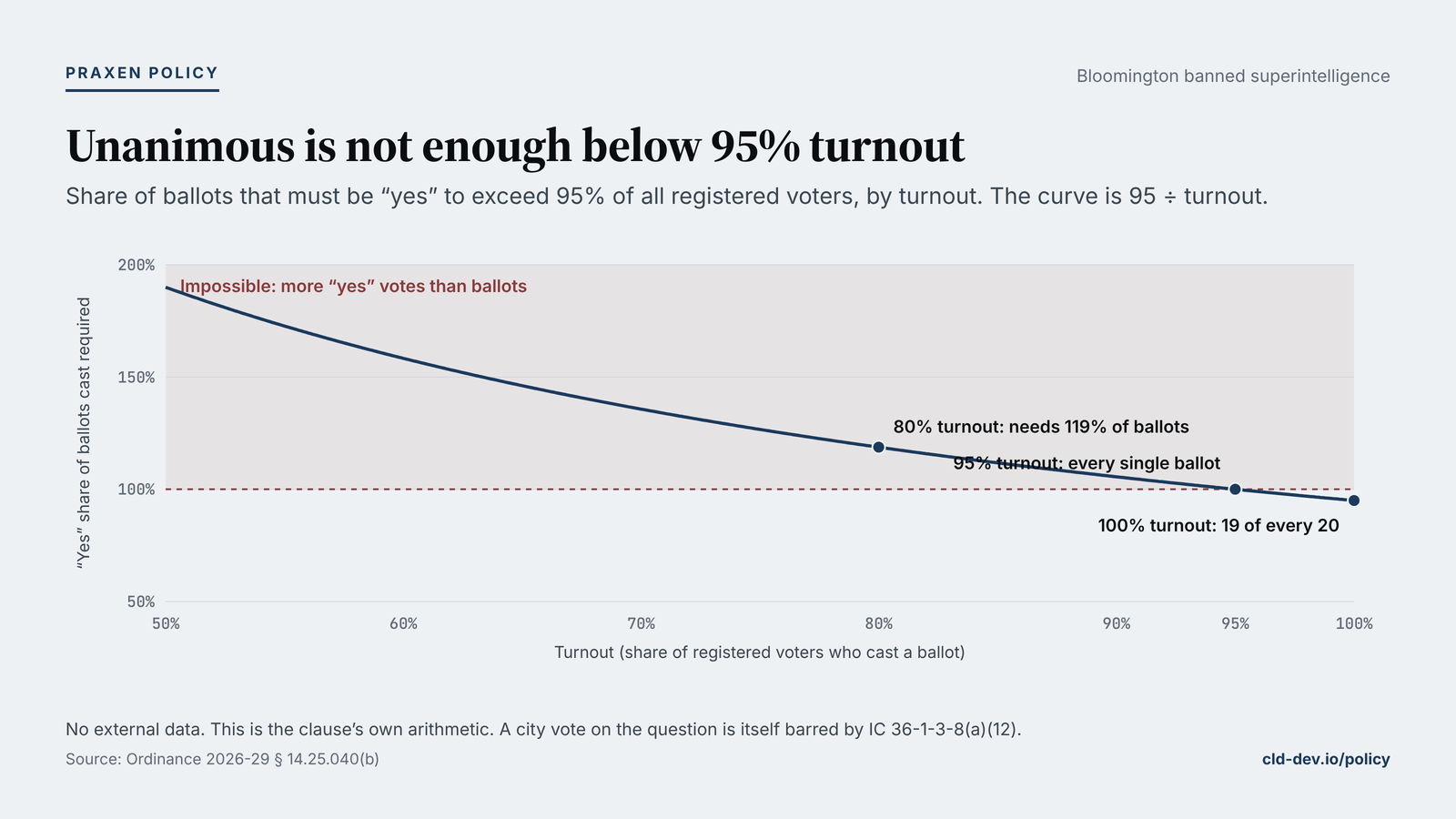
None of this would matter if the city could hold the vote. It cannot. And a successful vote would not lift the ban anyway; the Council would still have to pass a second ordinance making the “99.9999%” safety finding, a figure the ordinance borrows from nuclear-plant engineering without naming a standard or a method.17 Nothing, meanwhile, stops a future Council from repealing the chapter by simple majority. The clause binds no one and is void. It is there for the press release.
The federal layer: four orders, one task force, zero preemption
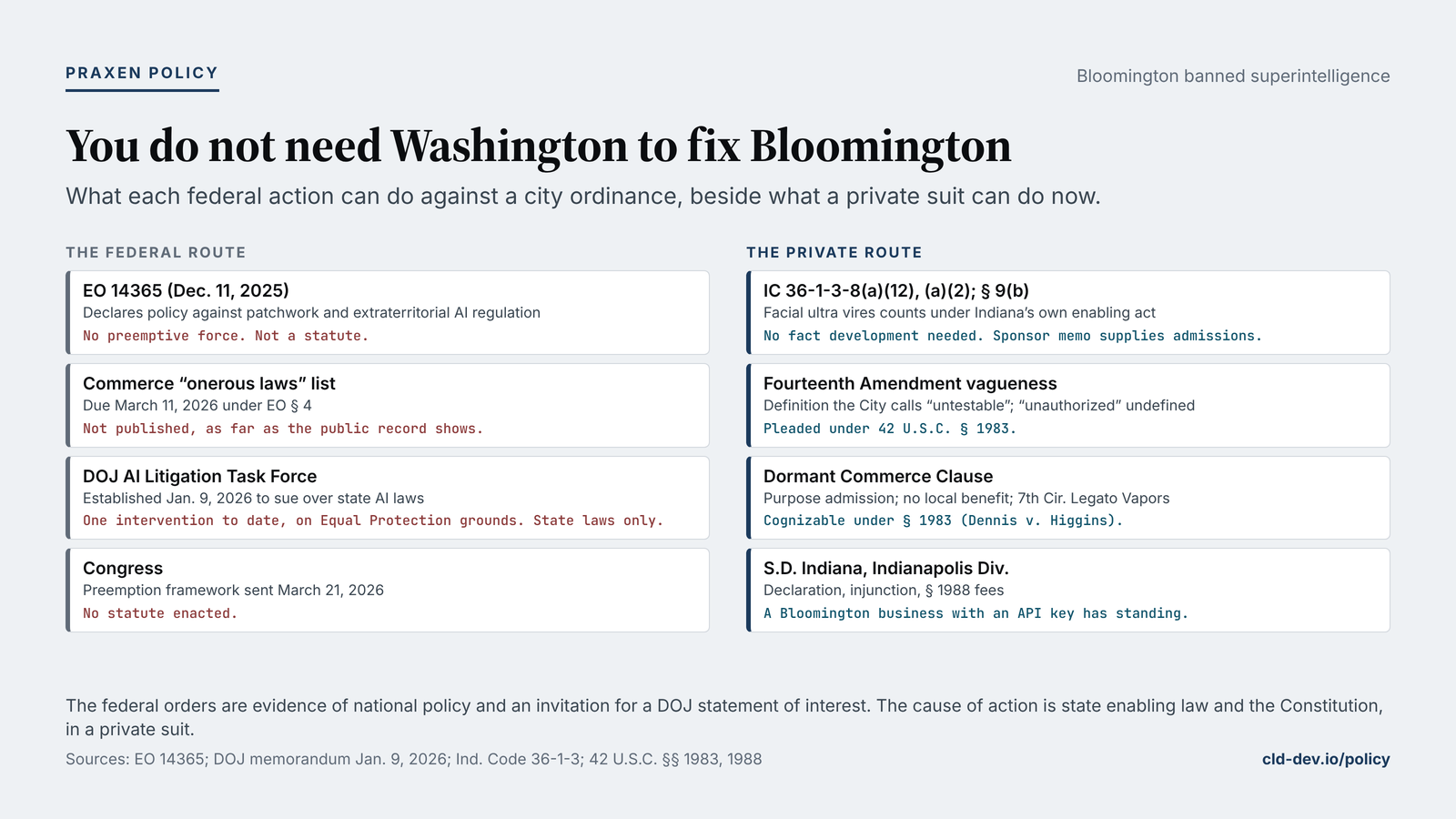
Since January 2025 the White House has issued four executive orders on AI and one Action Plan. EO 14179 revoked the prior administration’s order and directed agencies to remove regulatory barriers.16 Three July 2025 orders addressed data-center permitting, federal procurement of “truthful” models, and AI exports.17 EO 14365, signed December 11, 2025, is the one that matters here. It declares a policy of “a minimally burdensome national policy framework,” states that “State laws sometimes impermissibly regulate beyond State borders, impinging on interstate commerce,” orders the Attorney General to stand up an AI Litigation Task Force to challenge state AI laws “on grounds that such laws unconstitutionally regulate interstate commerce, are preempted by existing Federal regulations, or are otherwise unlawful,” and orders Commerce to publish a list of “onerous” state laws within ninety days.5
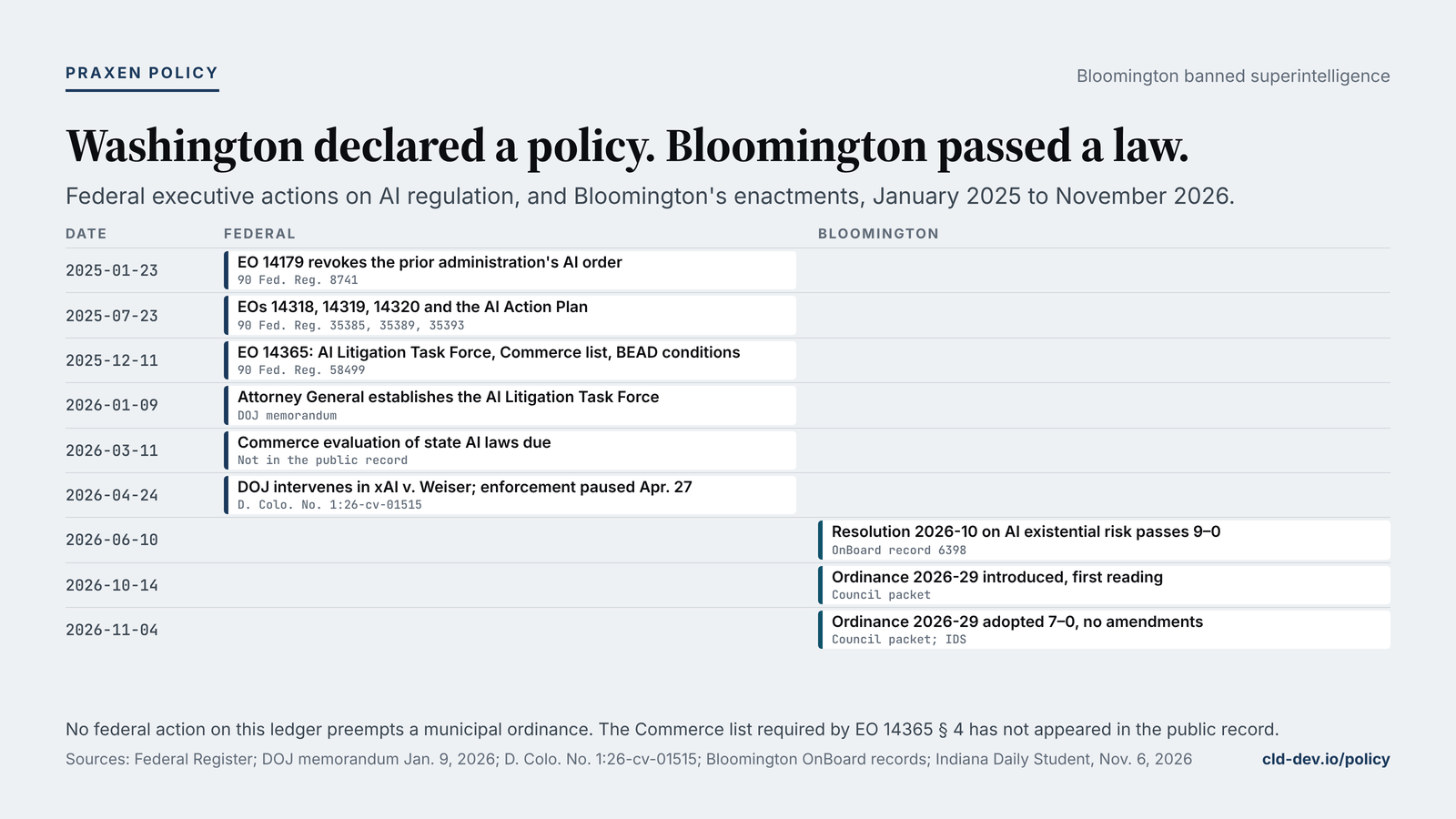
Here is what has happened since. The Task Force was established by memorandum on January 9, 2026.6 The Commerce list was due March 11; as far as the public record shows, it was never published.18 The Task Force has taken one action: on April 24, 2026, it intervened in xAI’s suit against Colorado’s algorithmic-discrimination law, and Colorado agreed three days later to pause enforcement.19 A White House legislative framework went to Congress on March 21. No preemption statute has passed.20
Two points follow, and I made both in Policy Analysis No. 1 in September.21 First, an executive order preempts nothing. The Supremacy Clause runs through acts of Congress, and there is no act of Congress. The orders are evidence of national policy, which is relevant to a court weighing a local law’s burden on interstate commerce, and they are an invitation to the Justice Department to file a statement of interest. They are not a cause of action. Second, you do not need them. The Bloomington ordinance falls under Indiana’s own enabling statute and under Commerce Clause doctrine the Seventh Circuit applied to Indiana a decade ago. A private plaintiff with an API key and standing can get there without Washington.
What the City will say
The City’s best argument is that home rule is broad, doubts are resolved in its favor, and the Indiana Supreme Court upheld a town’s groundwater ordinance against a home-rule challenge in Town of Avon in 2011.22 The answer is that section 3 of the Act governs doubt and section 8 governs express denial; there is no doubt to resolve when the statute says “a unit does not have the following.” Avon regulated a physical aquifer inside its boundaries. It did not hold an election, design private litigation, or regulate servers in other states.
The City will cite City of Gary v. Smith & Wesson, in which the Indiana Supreme Court let a city’s public-nuisance suit against gun manufacturers proceed.23 That was a lawsuit with pleaded facts, not an ordinance declaring a product class a nuisance per se with no local harm alleged. It is also over: the General Assembly reserved such suits to the State in 2024, and the Court of Appeals ordered the case dismissed last December, calling the city “an agent subject to the control of the State.” The Indiana Supreme Court declined to hear it in May.24
The City will say the ordinance is interim and yields to the state. An ordinance the city had no power to enact is void from the day it is signed; a sunset clause does not manufacture authority.
The City will say Ross ended extraterritoriality doctrine. It did not end discriminatory-purpose analysis or Pike balancing, and the memo’s “outside commercial tech entities” sentence is a purpose admission that survives Ross intact.
Finally, the City will say the precautionary principle justifies acting first on an existential risk. I take the risk seriously enough to have written about it. A city that cannot test for the thing it bans, cannot enforce the ban, and admits both in its own memo has not taken a precaution. It has passed a resolution with a fine attached.
My view
I build AI systems for a living. I have a commercial interest in how this goes, and I say so below. I also think the ordinance is bad law on its own terms, before anyone gets to the policy. A city council that wants to act on AI has real tools: procurement rules, disclosure requirements for city use, data-center siting and utility conditions, which EO 14365 expressly leaves to local government. Bloomington used none of them. It wrote a ban it cannot define, cannot enforce, and cannot lawfully repeal, and it told the public the ban would bind 350 other cities.
The first municipal AI ban to reach a courtroom will decide whether the next 349 get drafted. That is why this one matters, and why the complaint is attached. The mayor can still veto it. If she does not, an Indiana lawyer with a Bloomington client can file.
What is in the package and who it is for
This brief is published with five documents. A research memorandum sets out the questions presented, the facts, and the analysis, with a verification record for every authority. A memorandum of law supports a motion for preliminary injunction in the form a federal court expects. A verified complaint for the Southern District of Indiana carries placeholders for the plaintiffs. A demand letter to the Mayor and Corporation Counsel asks for a veto or a non-enforcement commitment within ten days. A public-records request under IC 5-14-3 asks the City for the Department of Law review, if one exists, and for the template the ordinance was drafted from. Anyone can send that last one; no lawyer is needed.
If you run a business inside Bloomington that calls a frontier-model API, you are a regulated party under section 14.25.030 whether or not the City can tell. If you build AI anywhere and have a customer in Bloomington, so are you. Take the package to Indiana counsel. Praxen is not a law firm and does not represent anyone in this matter.
Documents
- Full package (79 pp): brief + all five counsel documents
- This brief as a PDF (13 pp)
- Research memorandum for Indiana counsel (21 pp)
- Memorandum of law, motion for preliminary injunction (12 pp)
- Verified complaint, S.D. Ind. (23 pp)
- Pre-suit demand letter, template (3 pp)
- Public-records request under IC 5-14-3 (2 pp)
Praxen is not a law firm. Every document in this package is a draft for Indiana-licensed counsel.
Notes
-
Ordinance 2026-29, Common Council of the City of Bloomington, as introduced October 14, 2026 and adopted November 4, 2026. Mirror of the October 14 packet pages: https://bloomdocs.org/wp-content/uploads/simple-file-list/2026-10-14-Bloomington-city-council-Ord-2026-29-Artificial-Intelligence-Rollo.pdf. The adopted text, identical, is at pages 156–166 of the November 4 packet, https://bloomington.in.gov/onboard/meetingFiles/17709/download. Quotations are verbatim, including “99.9999% percent.” ↩ ↩2 ↩3 ↩4 ↩5 ↩6 ↩7
-
Zoe Reed, “Bloomington city council bars superintelligent AI, dismisses removal of commission member,” Indiana Daily Student, November 6, 2026, https://www.idsnews.com/article/2026/11/bloomington-city-council-ai-commission-member-removal-udo. Vote reported as unanimous with Zulich and Rosenbarger absent; the sponsor’s press release gives 7–0. ↩
-
Indiana Code, Title 36, Article 1, Chapter 3 (2026), https://iga.in.gov/ic/2026/Title_36.html. Sections 3, 4, 5, 8(a)(2), 8(a)(7), 8(a)(12), and 9(b) were read in the 2026 code. Section 8(a)(12) also voids pre-2023 local election ordinances absent express statutory authority. ↩ ↩2 ↩3 ↩4
-
Council Staff Memorandum, “Ordinance 2026-29 On the Existential Risk of Artificial Intelligence,” from Council Member Rollo and the Bloomington Council’s Office, October 14, 2026, reproduced without change in the November 4 packet (note 1). The “Section 2.90.040” reference appears on page 2 of the memorandum in both packets. ↩ ↩2 ↩3 ↩4 ↩5 ↩6
-
Executive Order 14365, “Ensuring a National Policy Framework for Artificial Intelligence,” December 11, 2025, 90 Fed. Reg. 58499. Text as reproduced in the notes to 15 U.S.C. § 9401, https://uscode.house.gov/view.xhtml?req=(title:15%20section:9401%20edition:prelim), and at https://www.whitehouse.gov/presidential-actions/2025/12/eliminating-state-law-obstruction-of-national-artificial-intelligence-policy/. The quoted language is from sections 1, 3, and 4. Section 8 carves out “child safety protections,” “AI compute and data center infrastructure,” and “State government procurement and use of AI” from any proposed preemption legislation. ↩ ↩2
-
Office of the Attorney General, memorandum, “Artificial Intelligence Litigation Task Force,” January 9, 2026, https://www.justice.gov/ag/media/1422986/dl. ↩ ↩2
-
Dave Askins, “Analysis: Bloomington’s proposed superintelligence ban raises questions about authority, enforcement,” B Square Bulletin, October 11, 2026, https://bsquarebulletin.com/analysis-bloomingtons-proposed-superintelligence-ban-raises-questions-about-authority-enforcement/. Source for the $2,500 general penalty, the per-day rule, the 2023 withdrawal after Indiana University’s objection, and the observation that a future council could repeal by simple majority. ↩ ↩2 ↩3
-
Resolution 2026-10, “On the Existential Risk of Artificial Intelligence,” adopted June 10, 2026, 9–0, https://www.bloomington.in.gov/onboard/committees/1/legislation/6398. ↩
-
Common Council Regular Session packet, November 4, 2026, https://bloomington.in.gov/onboard/meetingFiles/17709/download. The Ordinance 2026-30 memorandum, from Mayor Thomson, Corporation Counsel Margie Rice, and Controller Geoff McKim, follows immediately after the 2026-29 material. I read the full packet; no Department of Law material on 2026-29 appears in it. ↩ ↩2
-
Indiana Legislative Council, Artificial Intelligence Task Force, Final Report (2024), https://iga.in.gov/publications/committee_report/ai-task-force-final-report-2024.pdf; directive at IC 2-5-53.7-8. ↩
-
IC 4-13.1-5-3, https://law.justia.com/codes/indiana/title-4/article-13-1/chapter-5/section-4-13-1-5-3/. ↩
-
Indiana Management Performance Hub, “State of Indiana AI Policy and Guidance,” https://www.in.gov/mph/AI/. The Consumer Data Protection Act is IC 24-15, effective January 1, 2026, per Orrick’s Indiana tracker, https://ai-law-center.orrick.com/indiana/, a secondary source. ↩
-
Grayned v. City of Rockford, 408 U.S. 104, 108–09 (1972); Kolender v. Lawson, 461 U.S. 352, 357–58 (1983); FCC v. Fox Television Stations, 567 U.S. 239, 253 (2012). The “policemen, judges, and juries” language is Grayned’s. ↩ ↩2
-
Midwest Title Loans, Inc. v. Mills, 593 F.3d 660 (7th Cir. 2010); Legato Vapors, LLC v. Cook, 847 F.3d 825, 827 (7th Cir. 2017), https://www.courtlistener.com/opinion/4343620/legato-vapors-llc-v-david-cook/. The quoted sentence is from the opinion’s second paragraph. ↩
-
National Pork Producers Council v. Ross, 598 U.S. 356 (2023). The controlling portions of the opinion reject an “almost per se” extraterritoriality rule; the anti-discrimination principle and Pike v. Bruce Church, Inc., 397 U.S. 137 (1970), balancing are untouched. ↩
-
Executive Order 14179, “Removing Barriers to American Leadership in Artificial Intelligence,” signed January 23, 2025, 90 Fed. Reg. 8741, https://www.federalregister.gov/d/2025-02172. ↩
-
Executive Orders 14318 (data-center permitting, 90 Fed. Reg. 35385), 14319 (“Preventing Woke AI in the Federal Government,” 90 Fed. Reg. 35389), and 14320 (AI exports, 90 Fed. Reg. 35393), all signed July 23, 2025, https://www.federalregister.gov/documents/2025/07/28. ↩
-
The section 4 evaluation was due March 11, 2026. Legal 500 reported it unpublished on March 24 (https://www.legal500.com/intelligence/united-states/technology/the-curious-case-of-executive-order-14365%E2%80%99s-impact-on-ai-regulation); an AI-governance tracker corrected its own entry on September 30 to record non-publication as of April (https://aigovernance.com/policy/commerce-department-evaluation-state-ai-laws-2026). Two secondary sources say it was published on the deadline. I searched commerce.gov and ntia.gov on November 7 and found no document. If one exists, I will correct this note. ↩
-
X. AI LLC v. Weiser, No. 1:26-cv-01515 (D. Colo., filed April 9, 2026), https://www.courtlistener.com/docket/73171074/; United States’ Complaint in Intervention, April 24, 2026, https://www.justice.gov/crt/media/1437846/dl; Ashley Gold, “Justice Department joins xAI challenge to Colorado AI law,” Axios, April 24, 2026, https://www.axios.com/2026/04/24/justice-department-joins-xai-challenge-colorado-ai-law. The DOJ complaint pleads Equal Protection only; xAI’s complaint carries the Commerce Clause count. ↩
-
White & Case, “State AI laws under federal scrutiny,” January 15, 2026, https://www.whitecase.com/insight-alert/state-ai-laws-under-federal-scrutiny-key-takeaways-executive-order-establishing (“Since Congress has not yet passed a federal AI law that preempts state AI laws …”); on the March 21 legislative framework, see the Oregon district-court conference paper “Your AI Is on Display,” https://ord.uscourts.gov/2026%20District%20Conference/Effective%20AI%20Panel%20-%20Your%20AI%20is%20on%20Display.pdf, at Part II.C, a secondary source. ↩
-
Chris Dukes, “What four state AI laws actually reach,” Praxen Policy, September 17, 2026, https://cld-dev.io/policy/what-four-state-ai-laws-reach/. ↩
-
Town of Avon v. West Central Conservancy District, 957 N.E.2d 598 (Ind. 2011), https://www.courtlistener.com/opinion/852108/town-of-avon-v-west-central-conservancy-district/. For the Home Rule Act limits as enforced, Indiana Department of Natural Resources v. Newton County, 802 N.E.2d 430, 432–33 (Ind. 2004), https://www.courtlistener.com/opinion/852950/indiana-department-of-natural-resources-v-newton-county/. ↩
-
City of Gary ex rel. King v. Smith & Wesson Corp., 801 N.E.2d 1222 (Ind. 2003). ↩
-
Smith & Wesson Corp. v. City of Gary, No. 24A-CT-2381, ¶¶ 43, 48 (Ind. Ct. App. Dec. 29, 2025) (applying IC 34-12-3.5-3, P.L. 170-2024), trans. denied (Ind. May 21, 2026). Every case cited in this brief and in the counsel documents was run through a citator pass on November 7, 2026; the results are in Appendix A of the research memorandum. ↩
Sources · 29 (20 primary)
-
Ordinance 2026-29 and Council Staff Memorandum, Oct. 14, 2026 (bloomdocs mirror)
-
State of Indiana AI Policy and Guidance, Management Performance Hub
-
Executive Orders 14318, 14319, 14320, Federal Register issue of July 28, 2025
-
Attorney General memorandum, AI Litigation Task Force, Jan. 9, 2026
-
United States' Complaint in Intervention, X. AI LLC v. Weiser, Apr. 24, 2026
-
Town of Avon v. W. Cent. Conservancy Dist., 957 N.E.2d 598 (Ind. 2011)
-
Smith & Wesson Corp. v. City of Gary, No. 24A-CT-2381 (Ind. Ct. App. Dec. 29, 2025)
-
AI Governance tracker, Commerce evaluation entry (corrected Sept. 30, 2026)
-
Praxen Policy, What four state AI laws actually reach, Sept. 17, 2026
Disclosures
- Interests
- Praxen Development & Engineering, LLC builds and sells AI systems, including agentic systems of the kind Chapter 14.25 may reach, so it has a commercial interest in how AI is regulated. Read this piece with that in mind.
- AI assistance
- AI assisted research, drafting and editing. Every statute, executive order and opinion cited was opened in primary form during drafting; the verification record is Appendix A of the research memorandum published with this brief. Chris Dukes reviews every sentence before a piece is published.
- Standards
- Every factual claim links to its source, and errors are corrected in public with a date. See the editorial standards and the corrections log.
- License
- CC BY-NC 4.0. Views are the author’s own. Analysis, not legal advice. Praxen is not a law firm and does not represent any party in this matter.
Cite this piece
Chris Dukes. "Bloomington banned superintelligence. Its own statute says it couldn't." Praxen Policy, 7 November 2026. https://cld-dev.io/policy/bloomington-banned-superintelligence/